
Which Orthodontic Treatment Is Right for Me?
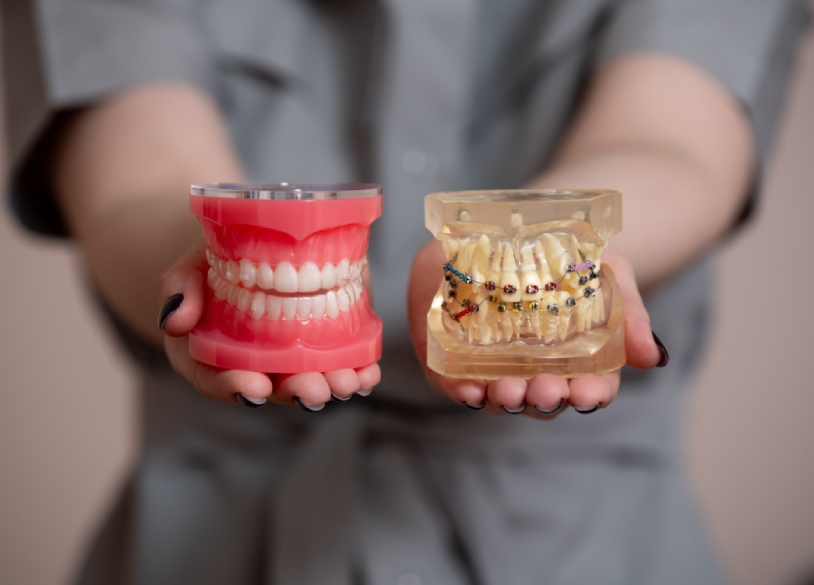
Invisalign®, traditional braces, and CandidPro™ can all straighten teeth, but they differ in comfort, visibility, cost, and how closely they’re monitored by a dental professional. The right choice depends on your bite, your lifestyle, and how involved you want your dentist to be in the process.
Crooked teeth, gaps, and bite issues are more than a cosmetic concern, as they can affect how you chew, speak, and even how easily you keep your teeth clean. The good news is that orthodontic treatment has come a long way from the one-size-fits-all metal brackets of the past. Today, patients have real choices, and each option comes with its own set of trade-offs.
At Legacy Dental Care, our Blaine dentists work with patients every day to figure out which path makes the most sense for their smile, their schedule, and their budget.
Available Orthodontic Treatments
Invisalign®
For most adults and teens exploring orthodontic treatment, Invisalign® has become the go-to option. Instead of metal wires and brackets, Invisalign® uses a series of custom-made, clear plastic aligners that gradually shift your teeth into place. Since the trays are virtually invisible, many patients say they forget they’re even wearing them.
Beyond the cosmetic advantage, Invisalign® offers a level of convenience that traditional braces simply can’t match. The aligners are removable, so you can take them out to eat, brush, and floss normally. This means no navigating food stuck in brackets or special tools to clean around wires. That said, Invisalign® only works if you’re disciplined about wearing your aligners 20 to 22 hours a day, swapping to a new set roughly every one to two weeks as directed by your dentist.
Our team can take digital scans of your teeth, map out your entire treatment plan using 3D imaging, and check your progress in person throughout treatment. That means if something isn’t tracking the way it should, such as a tooth moving too slowly or an aligner not fitting quite right, it gets caught and corrected early, rather than after months of misalignment. Invisalign® tends to work best for mild to moderate crowding, spacing issues, and certain bite problems, and treatment typically takes anywhere from six months to a year and a half, depending on the complexity of your case.
Traditional Braces
Braces have been the standard for orthodontic correction for decades, and they remain the most effective option for complex cases. Since braces are fixed to your teeth and controlled entirely by your dentist or orthodontist, there’s no risk of forgetting to wear them or losing them.
Modern advancements have led to braces that are less bulky and more comfortable than the versions many of us remember from childhood. Smaller brackets, more discreet wire options, and even ceramic (tooth-colored) brackets have made braces far less noticeable than they used to be. Braces usually excel at cases that may be too complex for clear aligners to fully resolve on their own, including correcting significant crowding, severe bite misalignment, and rotated teeth. Treatment time can vary based on severity, but most patients wear braces for one to three years, with regular adjustment visits every four to six weeks to keep things on track.
CandidPro™
CandidPro™ is a newer option in the clear aligner space, and it’s worth understanding how it differs from Invisalign®. CandidPro™ is designed to be a dentist-monitored alternative to at-home aligner kits, combining the convenience of clear aligner therapy with professional oversight rather than a fully remote, unsupervised experience. Like Invisalign®, it uses a series of clear, removable trays custom-fitted to your teeth using digital scans.
CandidPro™ is often geared toward patients with mild alignment issues who want a straightforward, cosmetically focused correction rather than a complex bite adjustment. It may be a good fit for someone looking for a shorter treatment timeline and a simpler course of care.
Which Orthodontic Option Is Best for Me?
With three solid options on the table, it often comes down to matching the treatment to your specific concern. Here’s a closer look at how each one tends to perform against common orthodontic issues:
- Mild to moderate crowding or spacing: Invisalign® is usually the approach here. It can comfortably close small gaps and untangle mild crowding without the visibility of brackets and wires.
- Severe crowding or significantly rotated teeth: The fixed brackets of braces can apply more consistent, controlled force, which generally makes them better suited to teeth that need to travel a longer distance or rotate a significant degree.
- Bite issues (overbite, underbite, crossbite): Both Invisalign® and braces can address bite misalignment, but the severity matters. Mild to moderate bite problems often respond well to the guided aligner system of Invisalign®, while more pronounced bite discrepancies typically call for braces or Invisalign® paired with additional attachments.
- Minor cosmetic gaps or slight relapse after previous orthodontic treatment: This is where CandidPro™ tends to shine. If your teeth have shifted slightly since you had braces years ago, or you’re dealing with a small cosmetic gap rather than a structural bite issue, the more streamlined approach of CandidPro™ may get you results faster.
- Patients who struggle with removable devices: If you know you won’t reliably wear a removable aligner for the recommended hours each day, braces remove that variable entirely since they can’t be taken out or misplaced.
- Patients who want fewer office visits: Since CandidPro™ is built around a more efficient monitoring schedule, it can appeal to patients with tighter schedules, though the in-person check-ins for Invisalign® still offer more hands-on adjustments if your case changes along the way.
The bottom line: mild issues generally leave you with more flexibility to choose based on lifestyle and appearance, while more complex bite and alignment problems narrow the field toward Invisalign® with attachments or traditional braces. A conversation with our dentists is the best way to know which category your smile falls into.
Key Takeaways
- Invisalign® offers a nearly invisible, removable, and dentist-supervised way to correct mild to moderate alignment and bite issues.
- Traditional braces remain the most reliable option for severe crowding, rotation, or complex bite problems.
- CandidPro™ provides a clear aligner alternative suited to mild cosmetic corrections with professional monitoring.
- Treatment length and cost vary significantly by option, so a professional evaluation is the best way to get an accurate estimate for your case.
- The most appropriate treatment isn’t necessarily the newest or most popular one, but the one that matches your specific smile goals and bite needs.
The only way to know which orthodontic method will actually work for your teeth is with a proper evaluation. Schedule a consultation with our Blaine dentists and we’ll walk you through your options, answer your questions, and help you choose the path to a straighter smile with confidence.